ASTHMA AND BRONCHITIS
Obstructive and allergic lung diseases affect many cats and are sometimes called “asthma,” “bronchitis,” or “bronchial asthma.” Unfortunately, these
diseases are not easily classified and probably represent a variety of lung disorders. They do share a common finding of “hyper-responsive” or
“over-reactive” airways.
When the airway of a cat is sensitive to certain stimuli, exposure to these agents leads to narrowing of the airways. The inciting agents are usually
direct irritants to the airways or things that provoke an allergic response in the respiratory tract. Regardless of the cause, the end-result is the same:
muscle spasms in the bronchi (breathing tubes), buildup of mucus, and accumulation of cellular material. In particular, the inability to clear the
bronchi of this material leaves the cat susceptible to secondary infections.
The cat is most stressed during expiration (forcing air out of the lungs). Difficult expiration or “breathing out” is typical with obstructive lung disease.
Air may become effectively trapped in the lungs, causing them to over inflate. In some cases, this trapping leads to development of emphysema in
the cat.
Are some cats more likely to get asthma?
Obstructive lung disease is most common in cats from two to eight years of age. Siamese cats seem to be at
higher risk for developing asthma and bronchitis. Also, some reports indicate that it is more common in female cats.
What are the clinical signs?
Coughing and respiratory distress are the most commonly reported signs with obstructive lung disease. Coughing is a significant finding since there
are relatively few causes of coughing in the cat. Also, many cats assume a squatting position with the neck extending during these coughing
episodes. Wheezing is easily heard with the stethoscope and is sometimes so loud that it can be heard by the owners. Occasionally, sneezing and
vomiting are noted.
What causes asthma?
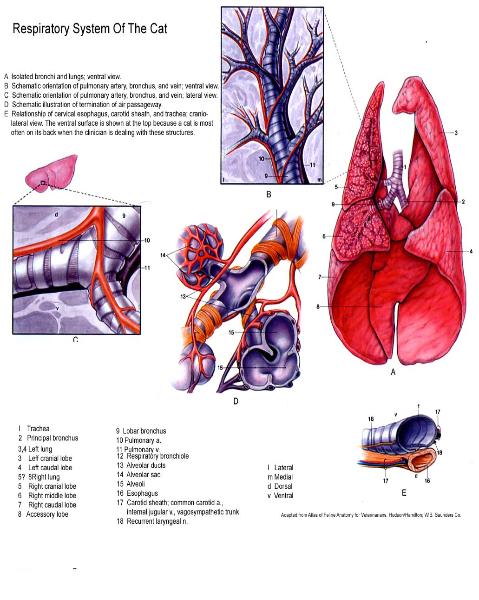
As mentioned above, this group of diseases is characterized by hyper-responsive airways. The small breathing tubes (bronchi and bronchioles) can
react to a number of stimuli, such as:
1. Inhaled debris or irritants - dust from cat litter, cigarette smoke, perfume or hairspray, carpet fresheners, and perfumes in laundry detergent
2. Pollens or mold
3. Infectious agents - viruses, bacteria
4. Parasites - heartworms, lungworms
How is asthma diagnosed?
Several tests may be performed to diagnose allergic lung disease in the cat.
1. The minimum diagnostic tests include a complete blood count (CBC), blood chemistries, fecal exam and urinalysis.These tests will assess the
general health of the cat and may provide clues as to the underlying cause. One particular type of white blood cell, the eosinophil, is commonly
associated with allergic events and may provide support for a tentative diagnosis of asthma. Also, in some cats, special tests will be performed on
stool samples for evidence of lungworms.
2. Heartworm test. This is not indicated for all cats, as heartworms are less likely in some parts of the country. In areas where they are common,
however, even cats that stay completely indoors are still at risk. Heartworm tests for cats are an area of intense research interest and their reliability
is improving greatly.
3. Feline leukemia and feline immunodeficiency virus tests. These tests
are helpful in determining the overall health of the cat.
4. Thoracic radiography (chest X-ray). Characteristic changes in the
lungs are common on x-rays. Also, x-rays can be suggestive of heartworms
other types of heart and lung disease.
5. Bronchoscopy, cytology and airway lavage (washing). Bronchoscopy
is a procedure that allows the veterinarian to look down the airways of the
anesthetized cat with a fiberoptic scope. After a visual examination of the
airway is completed, the lining mucus of the bronchi may be sampled with a
small brush. The mucus can be examined under a microscope (cytology).
Finally, a small amount of sterile saline can be flushed into the airways to
retrieve samples of material from deep in the lung. This material can be
cultured for micro-organisms and can also be carefully studied under the
microscope. The sediment can be evaluated for evidence of lungworms.
In some cases, an underlying cause cannot be identified, despite a thorough
diagnostic workup. Even when the underlying cause is not identified, many
cats can achieve a reasonable quality of life with medical management.
Some owners decline the complete workup for a variety of reasons. In such
cases, it may be acceptable to treat the cat with a course of corticosteroids
(“cortisone” or “steroids”) since most asthmatic cats respond favorably to
these medications with few side-effects. However, this approach may create
two problems. Corticosteroids can worsen secondary bacterial infections;
therefore, prophylactic antibiotics are reasonable in cases where a workup
cannot be performed. Cats with heartworms often cough like cats with
asthma and will respond temporarily to corticosteroids. Therefore, cats in
locations where heartworms are common in dogs may be misdiagnosed as
having asthma.
How is asthma treated?
Successful management of allergic lung disease employs several therapies.
1. Any factors known to trigger or aggravate breathing problems should be avoided. In some cases, this may mean trying different brands of cat
litter, eliminating cigarette smoke from the home, etc. The previous list (see “Causes”) details some factors that should be considered. It is important
to pay close attention to environmental factors that may aggravate the condition.
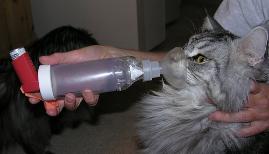
2. Bronchodilators. These drugs are used to open up the airway and allow the cat to move air more freely. They should be used faithfully and as
directed to obtain maximum effect.
3. Corticosteroids. Steroids have a beneficial effect on decreasing inflammation, dilating the airway,
and decreasing mucus production. In many cats, they are given daily. When the cat’s temperament is a
concern, long-acting injections can be given as an alternative to pills. These drugs have potential for
some side-effects and should not be withdrawn abruptly.
4. Emergency treatment may employ bronchodilators, oxygen, rapid-acting glucocorticoids, and
epinephrine. If your cat has heart disease, the attending veterinarian should be advised since
epinephrine is best avoided.
Will my cat recover?
Cats with obstructive lung disease are usually manageable. Sometimes “cure” may be achieved if a specific underlying cause can be identified and
treated.
Extreme respiratory distress constitutes an emergency and the cat should receive immediate attention.
INSTRUCTIONS
Those instructions that are specific for your cat have been checked
___ 1) An injection of corticosteroids was given. Relief should be apparent within 12-24 hours. If an increase in water consumption or urination
occurs, please inform us for future reference. These side-effects are common with steroid administration and will go away in a few days without
treatment. Return for further evaluation when the first signs of respiratory distress or noisy breathing returns.
___ 2) Begin oral corticosteroids. The specific drug being dispensed for your cat is labeled on the bottle. Give the tablets as directed:
______________________________________. Report any increase in water consumption to us at once.
___ 3) Begin oral bronchodilators. The specific drug being dispensed for your cat is labeled on the bottle. Give as directed:
___________________________________________
___4) In the event your cat has a respiratory emergency, seek the assistance of a veterinarian immediately.
Obstructive and allergic lung diseases affect many cats and are sometimes called “asthma,” “bronchitis,” or “bronchial asthma.” Unfortunately, these
diseases are not easily classified and probably represent a variety of lung disorders. They do share a common finding of “hyper-responsive” or
“over-reactive” airways.
When the airway of a cat is sensitive to certain stimuli, exposure to these agents leads to narrowing of the airways. The inciting agents are usually
direct irritants to the airways or things that provoke an allergic response in the respiratory tract. Regardless of the cause, the end-result is the same:
muscle spasms in the bronchi (breathing tubes), buildup of mucus, and accumulation of cellular material. In particular, the inability to clear the
bronchi of this material leaves the cat susceptible to secondary infections.
The cat is most stressed during expiration (forcing air out of the lungs). Difficult expiration or “breathing out” is typical with obstructive lung disease.
Air may become effectively trapped in the lungs, causing them to over inflate. In some cases, this trapping leads to development of emphysema in
the cat.
Are some cats more likely to get asthma?
Obstructive lung disease is most common in cats from two to eight years of age. Siamese cats seem to be at
higher risk for developing asthma and bronchitis. Also, some reports indicate that it is more common in female cats.
What are the clinical signs?
Coughing and respiratory distress are the most commonly reported signs with obstructive lung disease. Coughing is a significant finding since there
are relatively few causes of coughing in the cat. Also, many cats assume a squatting position with the neck extending during these coughing
episodes. Wheezing is easily heard with the stethoscope and is sometimes so loud that it can be heard by the owners. Occasionally, sneezing and
vomiting are noted.
What causes asthma?
As mentioned above, this group of diseases is characterized by hyper-responsive airways. The small breathing tubes (bronchi and bronchioles) can
react to a number of stimuli, such as:
1. Inhaled debris or irritants - dust from cat litter, cigarette smoke, perfume or hairspray, carpet fresheners, and perfumes in laundry detergent
2. Pollens or mold
3. Infectious agents - viruses, bacteria
4. Parasites - heartworms, lungworms
How is asthma diagnosed?
Several tests may be performed to diagnose allergic lung disease in the cat.
1. The minimum diagnostic tests include a complete blood count (CBC), blood chemistries, fecal exam and urinalysis.These tests will assess the
general health of the cat and may provide clues as to the underlying cause. One particular type of white blood cell, the eosinophil, is commonly
associated with allergic events and may provide support for a tentative diagnosis of asthma. Also, in some cats, special tests will be performed on
stool samples for evidence of lungworms.
2. Heartworm test. This is not indicated for all cats, as heartworms are less likely in some parts of the country. In areas where they are common,
however, even cats that stay completely indoors are still at risk. Heartworm tests for cats are an area of intense research interest and their reliability
is improving greatly.
3. Feline leukemia and feline immunodeficiency virus tests. These tests
are helpful in determining the overall health of the cat.
4. Thoracic radiography (chest X-ray). Characteristic changes in the
lungs are common on x-rays. Also, x-rays can be suggestive of heartworms
other types of heart and lung disease.
5. Bronchoscopy, cytology and airway lavage (washing). Bronchoscopy
is a procedure that allows the veterinarian to look down the airways of the
anesthetized cat with a fiberoptic scope. After a visual examination of the
airway is completed, the lining mucus of the bronchi may be sampled with a
small brush. The mucus can be examined under a microscope (cytology).
Finally, a small amount of sterile saline can be flushed into the airways to
retrieve samples of material from deep in the lung. This material can be
cultured for micro-organisms and can also be carefully studied under the
microscope. The sediment can be evaluated for evidence of lungworms.
In some cases, an underlying cause cannot be identified, despite a thorough
diagnostic workup. Even when the underlying cause is not identified, many
cats can achieve a reasonable quality of life with medical management.
Some owners decline the complete workup for a variety of reasons. In such
cases, it may be acceptable to treat the cat with a course of corticosteroids
(“cortisone” or “steroids”) since most asthmatic cats respond favorably to
these medications with few side-effects. However, this approach may create
two problems. Corticosteroids can worsen secondary bacterial infections;
therefore, prophylactic antibiotics are reasonable in cases where a workup
cannot be performed. Cats with heartworms often cough like cats with
asthma and will respond temporarily to corticosteroids. Therefore, cats in
locations where heartworms are common in dogs may be misdiagnosed as
having asthma.
How is asthma treated?
Successful management of allergic lung disease employs several therapies.
1. Any factors known to trigger or aggravate breathing problems should be avoided. In some cases, this may mean trying different brands of cat
litter, eliminating cigarette smoke from the home, etc. The previous list (see “Causes”) details some factors that should be considered. It is important
to pay close attention to environmental factors that may aggravate the condition.
2. Bronchodilators. These drugs are used to open up the airway and allow the cat to move air more freely. They should be used faithfully and as
directed to obtain maximum effect.
3. Corticosteroids. Steroids have a beneficial effect on decreasing inflammation, dilating the airway,
and decreasing mucus production. In many cats, they are given daily. When the cat’s temperament is a
concern, long-acting injections can be given as an alternative to pills. These drugs have potential for
some side-effects and should not be withdrawn abruptly.
4. Emergency treatment may employ bronchodilators, oxygen, rapid-acting glucocorticoids, and
epinephrine. If your cat has heart disease, the attending veterinarian should be advised since
epinephrine is best avoided.
Will my cat recover?
Cats with obstructive lung disease are usually manageable. Sometimes “cure” may be achieved if a specific underlying cause can be identified and
treated.
Extreme respiratory distress constitutes an emergency and the cat should receive immediate attention.
INSTRUCTIONS
Those instructions that are specific for your cat have been checked
___ 1) An injection of corticosteroids was given. Relief should be apparent within 12-24 hours. If an increase in water consumption or urination
occurs, please inform us for future reference. These side-effects are common with steroid administration and will go away in a few days without
treatment. Return for further evaluation when the first signs of respiratory distress or noisy breathing returns.
___ 2) Begin oral corticosteroids. The specific drug being dispensed for your cat is labeled on the bottle. Give the tablets as directed:
______________________________________. Report any increase in water consumption to us at once.
___ 3) Begin oral bronchodilators. The specific drug being dispensed for your cat is labeled on the bottle. Give as directed:
___________________________________________
___4) In the event your cat has a respiratory emergency, seek the assistance of a veterinarian immediately.
 |
 |
 |
 |
 |
 |
 |
 |
 |
 |
 |
 |

| Animal Hospital of Fate 1001 North W.E.Crawford (Highway 66 in Fate) Rockwall, Texas 75087 972-722-0066 |
1001 North W.E.Crawford (Highway 66 in Fate) Rockwall, Texas 75087 972-722-0066 |
| The Staff of the Animal Hospital of Fate |