FELINE HYPERTENSION
Hypertension is the medical term for high blood pressure.
Which cats are likely to get high blood pressure?
In humans, hypertension is related to several factors, including a stressful lifestyle and obesity. Although
not all causes of feline hypertension have been identified, stress does not appear to play a role in the
development of this disorder in cats. However, kidney, thyroid, and heart disease are known to cause
feline hypertension and will be described in detail.
What are the clinical signs?
Visual abnormalities are the most common clinical findings with feline hypertension. These abnormalities can include dilated pupils that
do not constrict with light, blood within the chamber of the eye, and blindness. Blindness develops because high blood pressure in the eye
causes the retina to detach. These cats run into objects in their path because many become blind.
In some cases, hypertension is suspected because of a heart murmur or kidney-related signs, such as increased water intake or urination.
What causes hypertension?
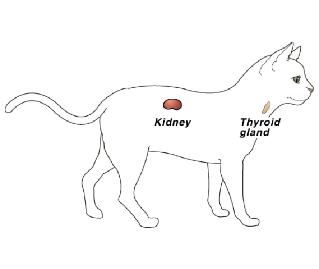
Kidney failure and hyperthyroidism have been identified as the two most common
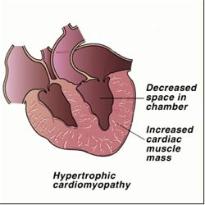
predisposing factors for development of feline hypertension. Certain heart diseases can
also cause hypertension.
Kidney disease. It appears that several different mechanisms may lead to development
of hypertension in cats with kidney disease. One theory suggests that as a cat ages, the
kidneys undergo normal aging changes, including a slow accumulation of scar tissue.
With time, this scar tissue causes the kidneys to shrink in size. When the kidney shrinks,
it is harder for the blood to filter through. Because the kidneys normally receive 20% of
the blood with every heartbeat, blood backs up into the arteries and leads to an increase
in blood pressure. One study found that about 60% of cats in old-age kidney failure have
hypertension. Elderly cats in the early stages of kidney disease may also have hypertension.
Hyperthyroidism. The thyroid gland is located in the neck and plays a very important role in regulating the body's metabolic rate.
Hyperthyroidism is a disorder characterized by the overproduction of thyroid hormone and a subsequent increase in the metabolic rate.
This is a fairly common disease of older cats. Although the thyroid gland enlarges, it is usually a non-malignant change (benign). Less than
2% of hyperthyroid cases involve a malignant change in the gland.
Many organs are affected by this disease, including the heart. The heart is stimulated to pump
faster and more forcefully, and eventually, the heart enlarges to meet these increased demands
for blood flow. The increased pumping pressure leads to a greater output of blood and high
blood pressure. About 25% of cats with hyperthyroidism have high blood pressure, although
most of them do not have blood pressures high enough to cause blindness.
How is it diagnosed?
Hypertension should be suspected in any older cat with kidney disease or hyperthyroidism. Onset of sudden, unexplained blindness
should raise a strong suspicion for hypertension and the associated diseases should be considered. Also, the presence of a heart
murmur or kidney-related problems may signal the presence of a hypertensive state.
Blood pressure is determined with a device that can detect blood flow in arteries. Obviously,
the cat has very small arteries when compared to those of humans. Consequently, the standard
blood pressure equipment used on humans will not work on cats.
What is involved in treatment?
Although there are several drugs that are very effective in treating human hypertension,
none of these are approved for use in cats. Research efforts have determined that some
of these drugs are effective in cats. Studies are still being done in an effort to determine
which drugs are the safest and most reliable.
What is the prognosis?
The underlying disease that caused hypertension to develop must be cured or controlled. Long-term success depends on whether or not
this is possible. If the cat has kidney, heart, or thyroid disease, it is important to treat those conditions aggressively. Hyperthyroidism is
curable, but hypertrophic cardiomyopathy and old-age kidney failure are not. However, even those can be managed successfully in many
cats.
If the cat has blindness due to detached retinas, a medical emergency exists. Blood pressure must be lowered quickly for preservation of
vision. If the retinas remain detached for more than a day or two, the prognosis is poor for a return of normal vision. Therefore, the key to a
successful outcome is rapid diagnosis and early administration of the proper medication to lower blood pressure.
 |
 |
 |
 |
 |
 |
 |
 |
 |
 |
 |
 |

Animal Hospital of Fate 1001 North W.E.Crawford (Highway 66 in Fate) Rockwall, Texas 75087 972-722-0066 |
1001 North W.E.Crawford (Highway 66 in Fate) Rockwall, Texas 75087 972-722-0066 |
| Dusty B. Goucher, DVM The Staff of the Animal Hospital of Fate |