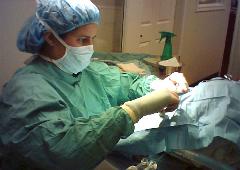
NEUTERING
Why should I have my cat neutered?
Males
Neutering, or castration, offers a number of advantages, especially if performed at an early age (4-9 months). Following puberty, at
approximately 8-9 months old, the male cat often develops a number of undesirable behavioral changes. He will become territorial
and start to mark areas, even inside the house, by spraying urine, which will have a particularly strong and difficult to remove odor.
He will start to enlarge his territory by straying ever farther from the house, particularly at night. It is for this reason that many cats hit
by cars are non-neutered males. By increasing his territory he will come into contact with other cats and fight for dominance.
Inflicted fight wounds can result in severe infections and abscesses. Since diseases such as FIV and FeLV, which can cause
AIDS-like syndromes and cancers in cats, are spread through bites, these cats are most commonly affected by such incurable
diseases. Finally, but not least, neutering prevents unwanted litters and the needless deaths of kittens and cats.
The longer a tomcat sprays and fights, the less likely neutering will stop it.
Females
Neutering, or spaying, in female cats also offers several advantages. Most obviously, it will prevent unplanned litters. Once a cat
reaches puberty (usually around 7 months), most of the year the queen will be “in heat” for approximately one week every two to
three weeks until she is mated. During “heat” she may display unsociable behavior such as loud and persistent crying and frequent
rubbing and rolling on the floor. Such behavior and her scent will attract tomcats from miles around. This will be eliminated by
spaying. Finally, spaying will remove the risk of uterine infection and cancer and may reduce the risk of breast cancer.
There is no medical reason for allowing your cat to have a litter before she is neutered.
When should I have my cat neutered?
In most cases, it is desirable to neuter before puberty, and it is customary to operate on kittens at an early age. The actual age
chosen will depend upon the preference of your veterinarian - many individuals will neuter both male and female cats at around 4-6
months old, however some operate at 2-3 months of age. Cats can be safely neutered at any age. It is possible to neuter when
pregnant. Please contact the hospital for further details regarding our neutering policy.
What does the operation involve?
Both male and female cats will undergo a general anesthetic. You will need to withhold food
for twelve (12) hours prior to surgery. Your pet should have free access to water during the
pre-operative fasting period.
In male cats, both of the testicles are removed through a small incision in the scrotum. Stitches
are rarely required in the skin.
In female cats, the operation is performed through a relatively small incision made in the midline
of the abdomen. Both ovaries are removed along with the uterus. Normally, skin stitches are
used that will be removed after 10 days after the surgery, unless absorbable material has been used.
What surgical complications could arise?
In general, complications are rare during neutering of kittens, however, as with all surgical procedures, there is always a small risk:
Anesthetic complication: It is possible that any pet could have an adverse reaction following the administration of any drug.
Such cases are impossible to predict, but are extremely rare. One potential danger arises from the cat not being fasted properly
prior to anesthesia. It is essential that all instructions are strictly followed. In addition, any signs of illness should be reported to
your veterinarian prior to an operation.
Internal hemorrhage: This can occur through ligature failure after the abdomen has been closed.
Post-operative infection: This may occur internally or around the incision wound. In most cases the infection can be controlled
with antibiotics.
Sinus formation: Although rare, occasionally the body will react to certain types of suture material used during surgery. This
results in a weeping wound that may appear some days or weeks after the surgery. Sometimes a second operation is required to
remove the offending material.
What adverse affects might neutering have on my cat?
In the vast majority of cases no adverse affects are noted following neutering. In certain cats, notably Siamese, the hair that grows
back over an operation site may be noticeably darker, due to a difference in the skin temperature. This darker patch may grow out
with the following molt as the hair is naturally replaced.
 |
 |
 |
 |
 |
 |
 |
 |
 |
 |
 |
 |

Animal Hospital of Fate 1001 North W.E.Crawford (Highway 66 in Fate) Rockwall, Texas 75087 972-722-0066 |
1001 North W.E.Crawford (Highway 66 in Fate) Rockwall, Texas 75087 972-722-0066 |
| The Staff of the Animal Hospital of Fate |